



By Alain Nuée, honorary President of the Versailles Court of Appeal, president of the EEEI Orientation Committee.
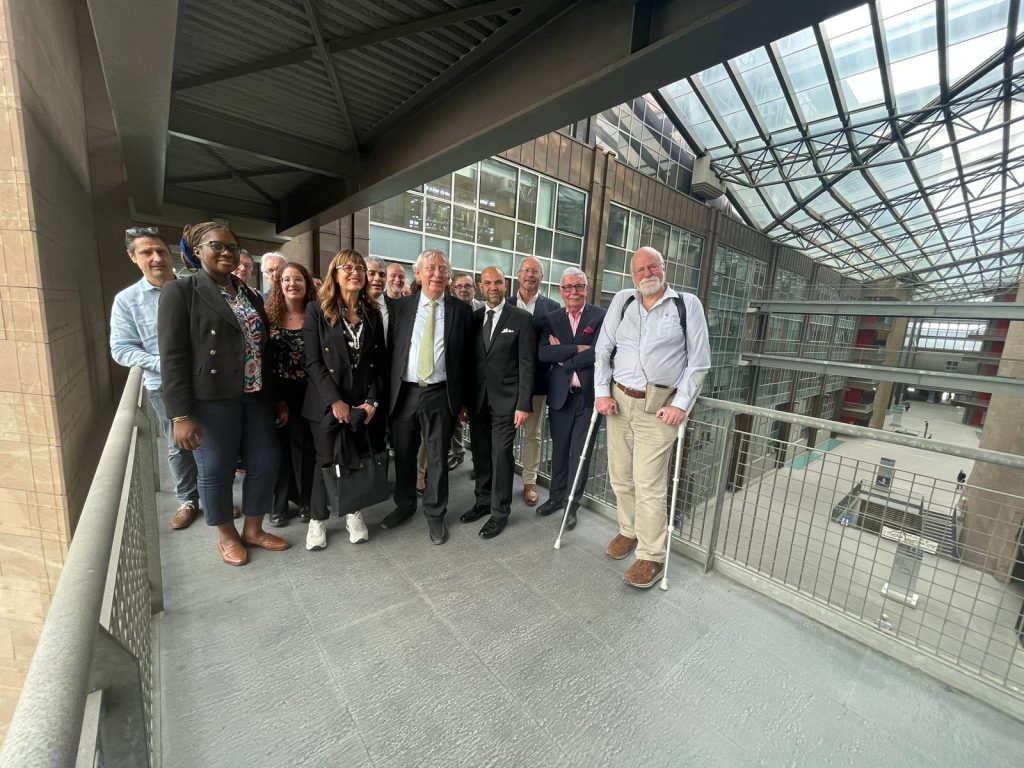
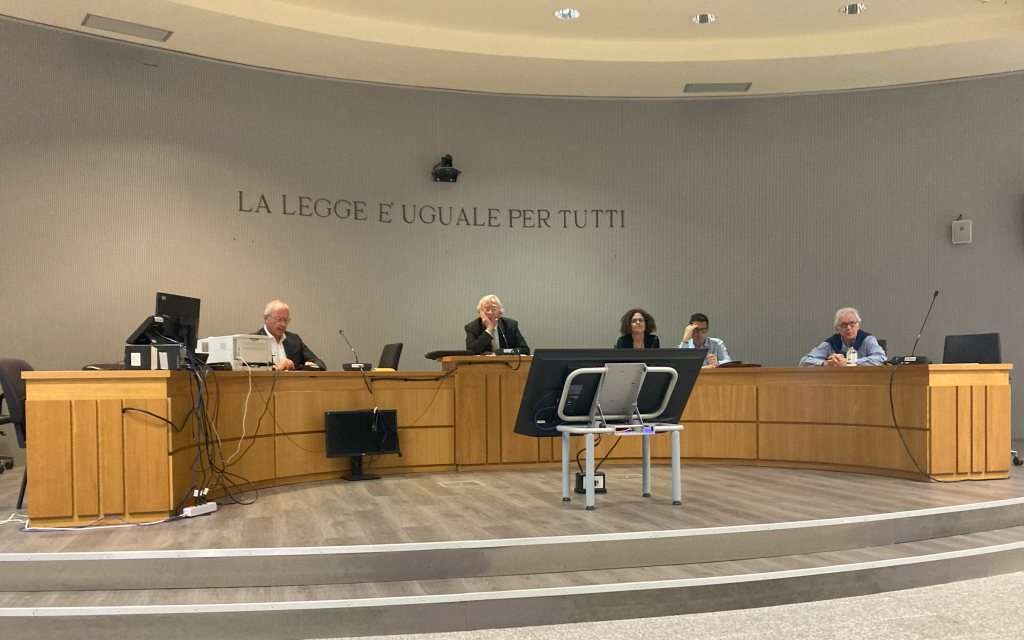
A meeting of the Orientation Committee took place on April 9, 2004 at the Florence Courthouse, at the invitation of Marilena Rizzo, President of the Court. Madam President did us the honor of guiding the visit and introducing participants to all the judicial services (court, court of appeal, public prosecutor’s office, justices of the peace) housed in the building designed by architect Leonardo Ricci, a pupil of Giovanni Michelucci. Officially inaugurated in 2012, the palace is named after Florentine jurist and politician Piero Calamandrei, one of the founders of the Italian Republic. Unique for its imposing size (240 meters long and 146 meters wide, with a 72-meter tower), it is one of the largest courthouses in Italy.
The role of the Orientation Committee
As a reminder, the Orientation Committee, confirmed as a fundamental constituent of the EEEI, must be one of the driving forces behind the latter’s action at a key moment in the life of the institute characterized by the estrangement of its founding members, the need to revisit the consensus that presided over its founding by questioning judges, lawyers and experts on their expectations of the EEEI and finally the obligation to increase and perpetuate its budgetary resources.
Four actions were discussed at the meeting:
1) Attempt to pursue the project for a list of European judicial experts with the Ministries of Justice of the pilot countries, and the funding of judicial experts;
2) Refocus on reflection, in particular by participating more actively in the work of the CEPEJ, and aim for the creation by the latter of a specific working group (GT-ex);
3) Maintain and develop links with EEEI members, and seek to recruit contacts in all EU countries;
4) Encourage the creation of national multidisciplinary associations of forensic experts, drawing on existing associations of forensic experts and/or associations of experts that include forensic experts;
With regard to funding, the idea was raised of extending the search for contributions from the 46 member states of the Council of Europe, which could ensure, at a lower cost to each state, the provision of an annual budget of 100,000 euros, guaranteeing the Institute’s independence and removing the need for it to obtain EU contracts.
Alain Nuée’s message
Given the importance of the issues addressed, and the need for in-depth discussions that go beyond the time allotted, it was felt necessary to set up focus groups for each of the actions identified, in the knowledge that their conclusions would have to be submitted in the second half of the year, to be implemented under the impetus of the new Chairman of the Steering Committee.
Indeed, after seventeen years of support for the EEEI and around ten years as Chairman of the Steering Committee, I felt it was essential to step down to give the Institute a new impetus. Having postponed this decision in the absence of a suitably qualified candidate, to the point of considering the appointment of an interim chairman who was not a magistrate, I was delighted to note that since the meeting of the Steering Committee in Florence, the EEEI has been fortunate enough to welcome Jean-Baptiste Haquet, currently Chamber President at the Nancy Court of Appeal and a member of the Conseil Supérieur de la Magistrature. President of three different courts, President Haquet has always been heavily involved in the management of expert appraisals, and the recruitment and appointment of experts. He was notably behind the creation of the seLEXpert software, designed to facilitate the search and appointment by the judge of the expert best qualified to give the opinion needed to resolve the dispute.
His wide-ranging knowledge of the judiciary and the public prosecutor’s office, his experience as head of a court, his participation in the constitutional body that appoints judges, combined with his dynamism and natural authority, make him an ideal candidate for the position of Chairman of the Steering Committee, which I strongly reaffirm should be held by a judge, given that it is the judge who obtains the opinion of the judicial expert, and that it is the presence of judges that gives the EEEI its originality and authority, distinguishing it from a mere association of judicial experts.
It is therefore with complete confidence that I leave these functions, as I am sure that President Haquet will give a new and decisive impetus to the Steering Committee and, through it, to the EEEI.
Alain Nuée


 Français