



Article by Priscilla Pisani, representing the EEEI in the CEPEJ Working Group on the quality of justice.
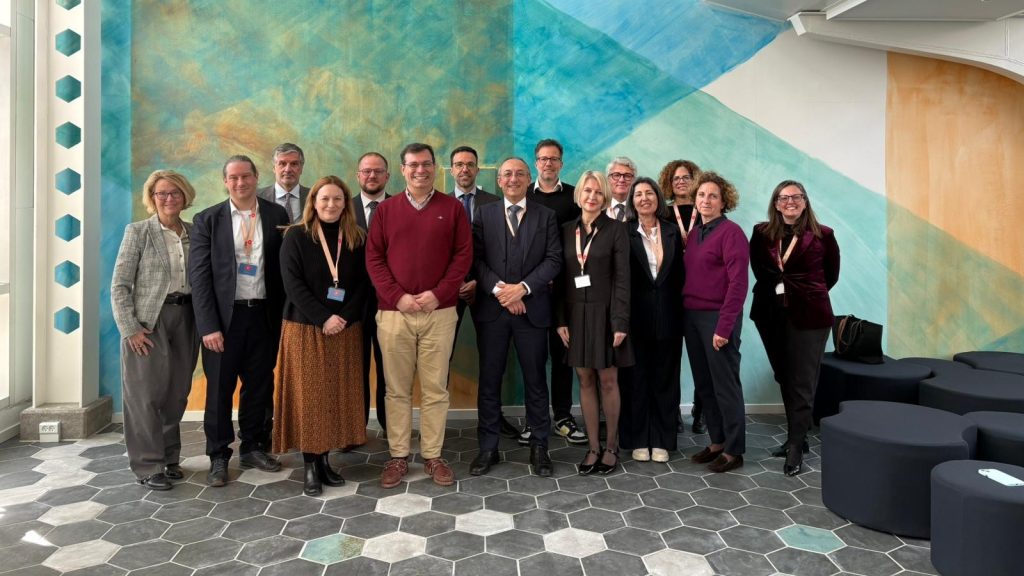
On 13 and 14 April 2026, the CEPEJ Working Group on the Quality of Justice (CEPEJ‑GT‑QUAL) gathered in Copenhagen for the first meeting of its 2026–2027 biennium.
The proceedings were opened personally by Francesco Depasquale, President of the CEPEJ, who attended the entire two-day meeting. In his opening remarks, he stressed the strategic importance of the Working Group’s mandate, framing its mission around two ideas that will run through everything the group does until the end of 2027: trust in the justice system, and a human‑centred justice that remains accessible, fair and transparent even as it becomes increasingly digitalised.
The members confirmed João Arsénio de Oliveira, Head of Department for International Affairs at the Portuguese Directorate‑General for Justice Policy, as chair of the group. President Depasquale and all members thanked him for the work accomplished in previous mandates and welcomed the continuity that his re-election will bring to a particularly dense agenda.
An ambitious two-year roadmap, kicked off in Copenhagen
In line with the CEPEJ Malta Plan and the 2026–2027 Activity Programme, the Working Group has set itself a far-reaching agenda: for each work stream, a lead contact and the contributing members were identified, and a first discussion and decision on how to proceed was held in Copenhagen:
- Charter on users’ trust and human‑centred justice – develop a Charter for promoting users’ trust and human-centred justice, in order to ensure that justice systems are accessible, fair and transparent in an increasingly digitalised environment, emphasising on “judgecraft” as well as ethical and human digital transformation.
- discussion on the way forward and on the working method.
- Interpretation in judicial proceedings – finalisation of the dedicated tool, in cooperation with the CEPEJ‑GT‑CYBERJUST.
- Discussion of the draft tool on interpretation in judicial proceedings
- Revision of the satisfaction surveys methodology – revision of the Manual for surveys among court users and development of a digital tool to support this activity.
- Presentation of the surveys currently being carried out in the United Kingdom.
- Discussion on the revision of the satisfaction surveys methodology.
- Discussion on the development of an IT tool for conducting satisfaction surveys.
- Environmental sustainability – preparation of a Checklist on the means to raise awareness and promote environmental sustainability practices within courts and judicial administrations.
- Information point on the workshop held during the meeting of the Pilot Courts and on the way forward.
- Review of the Guidelines on court-appointed experts – review of the Guidelines on the role of court-appointed experts in judicial proceedings of the member States of the Council of Europe.
- Discussion on the way forward and on the working method (see dedicated section below).
- Quality of justice indicators/indexes – reflect on the feasibility of developing indicators and/or indexes for measuring the quality of justice, in cooperation with the CEPEJ‑GT‑EVAL.
- Information point on the workshop held during the meeting of the Pilot Courts and on the way forward.
- Promote Mediation and ADR – developing one or more tools to raise awareness among justice users and professionals (judges, lawyers); and/or improving data collection on mediation within Member States, in cooperation with the CEPEJ-GT-EVAL.
- Discussion on the tool(s) to be selected for this mandate, the way forward and the working method.
- Work–life balance in the judiciary – joint work with the other CEPEJ working groups. Information point delivered at the meeting.
Access to justice for vulnerable persons – a new toolkit complementing the existing checklist on access to justice (planned for the mandate, not specifically discussed in Copenhagen
Focus on Review of the Guidelines on court-appointed experts
Among the items on the agenda, the review of the “Guidelines on the role of court-appointed experts in judicial proceedings of the member States of the Council of Europe” occupies a place of particular significance for the EEEI.
Opening the discussion, Jean‑Raymond Lemaire presented to the group a structured set of reflections that will guide the revision exercise. The members were invited to take into account, in particular:
- Diversity of legal systems – inquisitorial, accusatorial and mixed.
- Areas of expertise – civil, administrative and criminal proceedings.
- Profiles of experts – judicial experts appointed by the judge, party-appointed experts, expert witnesses and the role of “specialised laboratories”.
- Adversarial principle – its different weight depending on the procedure and on national codes of procedure.
- Good practices for expert assessments – adaptable, respectful of the sovereignty of States and focused on the quality of expert work, not on a top-down standardisation of national systems.
- Use of AI by experts – its impact on the efficiency and effectiveness of judicial proceedings.
- Costs and time limits – a recurrent concern for users and judicial systems.
- Quality of expert work – quality of reports and effective participation of experts in court hearings.
After a rich exchange among the members, the Working Group led to the decision to focus the review of the Guidelines on judicial expertise in civil and administrative matters and to introduce the topic of the use of AI, which will be addressed with the involvement of the CYBERJUST WG.
This orientation reflects, on the one hand, the operational reality of court-appointed experts across Europe and, on the other, the EEEI’s long-standing conviction that high-quality expertise is one of the conditions of public trust in justice.
Next planned meetings
- 18–19 June 2026 – CEPEJ Plenary, Šibenik.
- 19–20 October 2026 – Working Group meeting, Strasbourg.


 Français