Because today, sustainability is no longer just a matter of reputation or compliance, but a factor that directly affects financing, customer relations, talent, supply chains, permits and, for many entrepreneurs, the true value of the business – whether in the form of new opportunities (i.e. new markets), or in the form of significant efficiency gains. Furthermore, companies are increasingly being questioned by banks, investors, major clients and other stakeholders. Organisations that anticipate these issues in good time and manage their operations accordingly can better control risks whilst creating a competitive advantage.
Understanding the basics: ESG and the SDGs
Environmental, social and governance (ESG) criteria and the Sustainable Development Goals (SDGs) are complementary. The SDGs correspond to the United Nations’ 17 Sustainable Development Goals and set out a comprehensive global roadmap for society. ESG, on the other hand, provides a business-oriented framework for translating sustainability challenges into concrete terms in terms of policies, governance, risk analysis, key performance indicators (KPIs) and reporting. A company can therefore draw inspiration from the SDGs to define its ambitions and its contribution to society, whilst ESG helps it to make these ambitions operational, measurable and transparent in its reporting.
A guide to support European organisations
Who is this guide aimed at, and why did the IRE feel it necessary to publish it now?
The guide is primarily aimed at companies and organisations that are not, or not yet, subject to the Corporate Sustainability Reporting Directive (CSRD), but which are already facing growing demands regarding ESG. The document is also useful for companies wishing to prepare for future obligations (so-called ‘wave 2’ companies). The IRE felt it was useful to publish it now because the reporting framework is still in the process of stabilising, whilst demand for reliable sustainability information is growing rapidly and organisations, both large and small, need practical, high-quality guidance.
How does this guide address the growing demand from businesses?
The guide provides practical answers to the questions that businesses and organisations, both large and small, are already being asked by banks, investors, customers, suppliers and employees. Many organisations are looking for guidance on how to integrate sustainability initiatives into their strategy and business model, which aspects of governance and oversight need to be developed, which standards to use, which data is a priority, and how to produce credible reporting. The guide translates this need into a practical framework, taking into account both mandatory and voluntary reporting, as well as how the auditor can add value to the process.
What value does a statutory auditor bring to the ESG process?
The auditor brings a systematic approach, an independent perspective and expertise in reporting, internal control and assurance. They can help to select the appropriate reporting framework, structure internal control processes and systems, enhance data reliability and improve the consistency between financial and non-financial information.
The added value therefore lies not only in the certification (assurance), but also in improving the quality, effectiveness and credibility of the information, as well as in preparing organisations for sustainability assurance, whilst independence must, of course, always be guaranteed.
The European regulatory framework: obligations and developments
What are the specific European standards and regulations applicable to businesses?
For large companies (listed companies with an average of more than 500 employees), the most relevant legislation today is primarily the CSRD, the European Sustainability Reporting Standards (ESRS) and the EU Taxonomy Regulation on sustainable activities, as well as the specific performance indicators associated with them. From the 2027 financial year onwards, the thresholds for mandatory sustainability reporting under the CSRD will be raised to apply to companies with an average of more than 1,000 employees and an average annual net turnover of €450 million, alongside an expected simplification of the ESRS standards.
In the area of voluntary reporting, the VSME standard – the voluntary sustainability reporting standard for unlisted micro, small and medium-sized enterprises – is currently a key framework (particularly following the European Commission’s specific recommendation in July 2025), alongside the GRI standards and, in certain contexts, the IFRS S1 and IFRS S2 standards developed by the International Sustainability Standards Board (ISSB).
The role of professionals: auditors, engineers and court-appointed experts
Why are auditors interested in sustainability, rather than engineers or project managers?
Sustainability requires both technical measures and knowledge of certain technical standards, such as the Greenhouse Gas (GHG) Protocol, as well as experience in reliable reporting, internal control systems, an understanding of materiality, consolidation principles and assurance techniques, whether mandatory or voluntary. Statutory auditors have experience across the full range of these skills, whilst engineers primarily contribute sector-specific and environmental technical expertise. In other words, the most robust approach is therefore a multidisciplinary one. Regarding the role of the court-appointed expert, we refer the reader to the section dedicated to this point later in this article.
Are there any ongoing legal proceedings relating to non-compliance or a lack of sustainability? Have any court-appointed experts been appointed?
Yes. In Europe, the number of legal proceedings relating to climate policy, greenwashing, misleading sustainability claims, the duty of care and human rights within the value chain is on the rise. Companies are coming under increasing scrutiny regarding their sustainability claims and the consistency between what they claim to do, the reality of their actions and the values they espouse.
Court-appointed experts may be appointed where it is necessary to establish technical facts, such as emissions measurements, data quality, causality, damage, or the reasonableness of the methods used. To date, it is still rare in Belgium for court-appointed experts to be involved in cases relating to sustainability, but this may, of course, change in the future.
ESG reporting in practice: requirements, data and implementation
1. On the reporting itself
What exactly does mandatory sustainability reporting under the CSRD entail, and how does it address stakeholders’ concerns?
The CSRD requires companies to include sustainability information in their management report or annual report, based on the ESRS standards. This includes, in particular, information on governance, strategy, impacts, risks and opportunities (IRO), policies, actions, targets and KPIs, all based on the principle of double materiality. Where applicable, information must also be provided on the value chain. For the companies concerned, this is accompanied by a mandatory limited assurance engagement carried out by an auditor or, in some countries, by what is known as an independent assurance service provider (IASP).
When it comes to stakeholders’ expectations, these often relate to issues such as greenhouse gas emissions, energy, water, waste, employee data, worker health and safety, diversity, human rights and ethics. Above all, it is essential that the data selected is relevant, explainable, comparable and sufficiently substantiated.
What are the consequences for companies that fail to comply with the regulations?
Failure to comply may result in sanctions from supervisory authorities and liability risks for directors, as well as making it more difficult to access finance, leading to a loss of clients or business, and damaging the company’s reputation. Furthermore, the risk of accusations of greenwashing or disputes with stakeholders increases when a company’s sustainability reporting—whether mandatory or voluntary—does not reflect reality. The auditor can, of course, help to prevent such situations.
2. On operational implementation
What challenges do companies face when it comes to collecting and ensuring the quality of ESG data?
The main challenges are generally as follows: (i) a lack of commitment on the part of the organisation’s management, (ii) a lack of integration into the company’s strategy, (iii) inadequate governance, (iv) fragmented and insufficiently substantiated data sources, (v) unclear responsibilities, (vi) missing definitions, (vii) limited IT support, and (viii) inadequate internal controls. Data relating to so-called Scope 3 emissions and information from the value chain still often pose a challenge for companies. In this regard, the proposed simplifications to the ESRS standards are likely to be welcomed by companies subject to the CSRD or wishing to undertake voluntary reporting.
How can a credible and verifiable ESG strategy be developed, and how can greenwashing be avoided?
A credible ESG strategy begins with clear support from the board of directors and senior management, robust governance, a well-founded materiality analysis and a realistic translation of these into priorities. This must be followed by clear objectives, a clear allocation of responsibilities, deadlines, KPIs, processes for establishing and collecting data, and robust internal controls. The strategy must also be visibly aligned with investment decisions, risk management and reporting. If it is not embedded throughout the organisation, it rarely remains credible.
It is also important to state transparently the limitations, assumptions and objectives that have not yet been achieved. Internal control, legal review and external assurance (by an auditor), whether mandatory or voluntary, which it is recommended to put in place, help to strengthen the credibility of the published information and reduce the risk of greenwashing. An auditor who does not act as a statutory auditor can also provide real added value as an advisor.
Outlook: supporting stakeholders
What educational resources or additional tools should be developed to support practitioners (experts, judges, academics) in analysing sustainability reports?
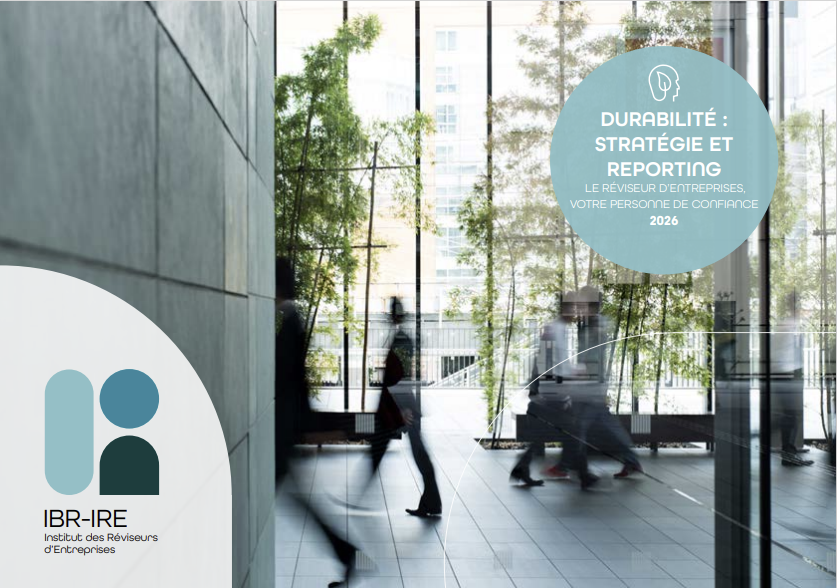
In addition to a sufficiently stable and clear regulatory framework, there is above all a need for practical, targeted guidance tailored to specific audiences. Publications such as the IRE’s brochure ‘Sustainability: Strategy and Reporting – The Statutory Auditor, a Trusted Professional’ seem to us to be very useful in this regard. For judges and court-appointed experts, there is a need for legal and operational tools, such as summary notes on relevant regulations, methodological guides for analysing sustainability reports and, as they become more widely available, overviews of case law and litigation relating to greenwashing, due diligence obligations, responsibility within the value chain and the reliability of ESG information. For academics, the added value lies more in the development of analytical frameworks, research/studies and training modules linking company law, reporting, assurance and sustainability.
We use cookies and similar technologies to ensure our website works properly, personalize your browsing experience, and analyze how you use our website. You can learn more about how we use cookies by visiting our privacy policy page You can choose below whether or not to enable cookies that are not essential to the operation of the site.
You can revoke your consent at any time by using the "Revoke consent" button.






 Français