



Interview with Jean-Baptiste Haquet, President of the Chamber of the Nancy Court of Appeal and designer of the seLEXpert digital tool.

EEEI — Could you give us an overview of seLEXpert, its status and tell us what needs/issues this tool addresses?
J-B Haquet — seLEXpert is both the name of a government start-up in the beta.gouv.fr programme run by the Interministerial Digital Department (DINUM) on behalf of the Ministry of Justice, and the name of the digital application that this start-up is developing to enable the informed selection and rapid appointment of legal experts thanks to :
- a more efficient search for compatible and available experts,
dematerialised pre-selection guaranteeing the expert’s agreement in principle within a specific timeframe.
- dematerialised pre-selection guaranteeing the expert’s agreement in principle within a specific timeframe.
seLEXpert has no legal personality, it belongs to the Ministry of Justice.
Our tool helps to solve the problem of the high number of refusals of assignments by legal experts, due to lack of availability or lack of suitability for their areas of expertise. The result is an additional workload for magistrates and court clerks, and consequently significant delays in the initiation of proceedings, which is detrimental to litigants.
EEEI — It is stated on the beta.gouv.fr website that “in the context of legal proceedings, 40% of assignments are refused by experts”, what is the source?
J-B Haquet — This is a figure based on a study carried out by the expertise control department of the Nancy judicial court.
EEEI — What was the process of co-construction with users?
J-B Haquet — We began by carrying out an “investigation” phase, which consisted of discussions by videoconference with judges, experts and court clerks on the need for and usefulness of such a tool. This need was confirmed. Suggestions have already been made during these discussions.
We continue to communicate regularly with experts and their national and regional representatives, either informally or at meetings of regional company bodies. We have a dedicated e-mail address where users can ask us questions or make comments, which are often very useful.
EEEI — Can you give us details of the dates (investigation period, development, first service launch, etc.)?
J-B Haquet — The investigation period was the last quarter of 2022; the first version of the tool was then developed and the first requests were made via seLEXpert in May 2023.
EEEI — Is there up-to-date functional and technical documentation?
J-B Haquet — There is no technical documentation at the moment, but functionally there are the following guide pages:
- Activation of justice and expert accounts,
- On the use for magistrates, court clerks, experts.
EEEI — What data will enrich the algorithm’s operation, and how long will it last?
J-B Haquet — SeLEXpert does not use an algorithm to recommend an expert. Experts are asked to indicate their availability, if necessary by specifying the beginning and end of their period of unavailability, particularly when they are asked to carry out an assignment. The tool does not propose a hierarchy of experts.
EEEI — What is the decision tree for recommending an expert?
J-B Haquet — There is no decision tree; the system works by filters (see below) and without recommendations.
EEEI — How is compatibility determined for the dematerialised pre-selection and appointment of an expert?
J-B Haquet — The magistrate may select any expert from the list for his request.
EEEI — What are the criteria and hierarchy?
J-B Haquet — The magistrate can filter the list of experts according to the following three criteria:
- the Court of Appeal with which the expert is registered (several courts may be selected),
- the geographical area in which the expert works, which can be refined in each expert’s file,
- the speciality for which the expert is registered.
EEEI —At what level of detail in the nomenclature?
J-B Haquet — The same level as that of the appeal court lists (A.1.1, A.1.2, etc.)
EEEI — How is gender balance taken into account, and other forms of discrimination more generally?
J-B Haquet — Experts are listed in alphabetical order, regardless of gender.
EEEI — Wouldn’t the principle of randomness be fair?
J-B Haquet — C’est une idée à laquelle nous n’avons pas encore réfléchi, pourquoi pas.
EEEI — Is certain information masked for this purpose?
J-B Haquet — No.
EEEI — How is real-time updating of information guaranteed? Is the information time-stamped?
J-B Haquet — All events relating to a request are time-stamped and recorded in the database.
EEEI — How are personal data processed, and can references be anonymised?
J-B Haquet — No, information relating to the identity of the parties is not currently anonymised. Only those involved in a given request (magistrate, attached court clerks, pre-selected experts) have access to the documents attached to the request.
EEEI — Are the RGPD rules being followed?
J-B Haquet — We follow the following RGPD principles:
- principle of lawfulness: data is processed lawfully, fairly and transparently and collected for specified, explicit and legitimate purposes,
- principle of data accuracy and updating (in concrete terms, users can update their data and it is in any case in seLEXpert’s interest that they do so),
- the principle of minimisation: data must be adequate, relevant and limited to what is necessary for the purposes for which it is to be used,
- the principle of limited data retention (in concrete terms, requests are archived after four months of non-activity – user data, on the other hand, is retained for the time being.).
Generally speaking, we can assume that we are not 100% RGPD-compatible, but that will happen as we go along. We will need to obtain certification from MonServiceSécurisé.
Data is hosted on CleverCloud in France. No data is publicly accessible on the Internet: you need to have an account to access seLEXpert. Not everyone can have an account: justice users must register with their @justice.fr address and experts must register with their address registered with the court of appeal.
EEEI — How does the seLEXpert platform measure up in terms of accessibility, and what can you tell us about RGAA compliance?
J-B Haquet — seLEXpert uses the government’s design system (https://www.systeme-de-design.gouv.fr/) and is therefore well on the way to being 100% accessible. All that remains to be done is to have an audit carried out (by us and then by a certifying body).
EEEI — How is the availability of an expert formalised and expressed?
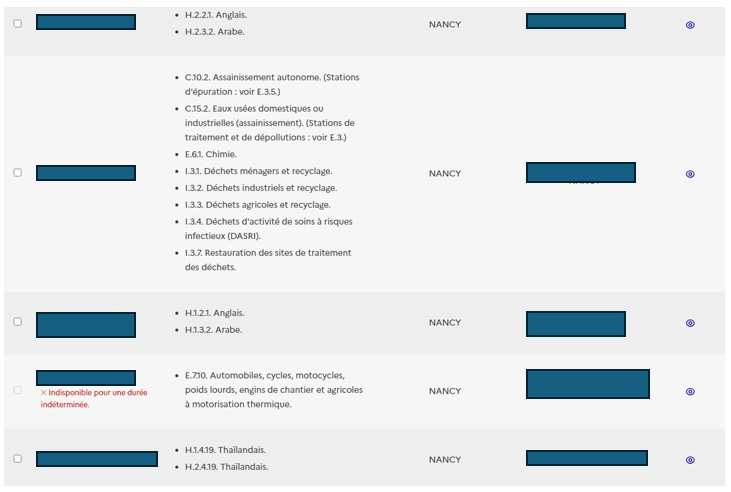
It appears openly in the tool, and is visible to user magistrates and registrars. Experts can update their availability themselves once their account has been activated (experts who have not yet activated their account are considered to be available by default).
If an expert is pre-selected and does not respond within the given timeframe, their non-response will be considered as a refusal and they will automatically be marked as unavailable and will no longer be selectable (but still visible in the list).
Applicants are informed of this system at the time of their pre-selection and at the time of their automatic refusal. They are also informed that they can log on to seLEXpert at any time to declare themselves available again (prior activation of the account is required). We also send a reminder email at seven and then fourteen days, and then every month, so that the expert is always aware of the posting of his unavailability and its consequences. All this is done to encourage experts to keep their availability up to date and to respond to requests (even if they refuse).
EEEI — Can repeated unavailability for various reasons (compliance with the right to disconnect or other reasons) be detrimental?
J-B Haquet — No, there is no objective reason for this.
EEEI — How can a response be guaranteed within a given timeframe?
J-B Haquet –Each expert has 48 working hours plus the time remaining until midnight to accept or decline the proposal. As the number of experts that can be called upon for a request is limited to five, the response is necessarily given within a constrained timeframe.
EEEI — What proportion of applications are accepted in less than 72 hours and refused in 72 hours or more?
J-B Haquet — The proportion of applications accepted in less than 72 hours out of the total number of applications is around 75%.
Access to public statistics seLEXpert (anje-justice.fr
EEEI — How are experts informed about this new tool?
J-B Haquet — By the presidents of the regional companies for the experts who are members, and in any case by the seLEXpert team’s development managers.
EEEI — Once an account has been created, what can an expert do?
J-B Haquet — They may accept or decline assignments when asked to do so, and they may amend any incomplete, obsolete or erroneous information in their seLExpert profile, including their availability.
EEEI — Is it to refine/add skills not included in the current nomenclature?
J-B Haquet — Yes.
EEEI — If so, how is the reliability of the information guaranteed?
J-B Haquet — There is no control mechanism, we trust the experts and rely on their ethics.
EEEI — How to protect yourself from abuse, a problem already encountered a few years ago.
The solution probably can’t come from us alone, but perhaps a joint reflection on this subject with the experts could be useful. We take good note of this suggestion.
EEEI — How many experts now have an account and use the platform?
J-B Haquet — 1,237 experts had created an account by 27 August 2024. We do not have statistics on the number of experts who have actually accepted or declined an assignment via seLEXpert.
EEEI — How many Courts of Appeal, local courts and the judiciary are users of the seLEXpert platform?
J-B Haquet — There are currently 4 courts of appeal, 12 judicial tribunals with regular users, and no local courts.
EEEI — How are judges and court clerks trained? Are there any initial and/or continuing training courses?
J-B Haquet — seLEXpert is extremely easy to use and does not require any ongoing training. The team’s deployment managers provide initial support for the tool (more than initial training) during videoconferences.
EEEI — Are job changes a problem?
J-B Haquet — Yes, and we are currently looking into this very issue. As it stands, we have opted to let magistrates declare themselves in seLEXpert that they have changed their posting.
EEEI — How do you express your availability to the judge?
J-B Haquet — They can view the availability of experts directly by logging on to the application.
EEEI — What is the development strategy for the seLEXpert platform over the coming months/years?
J-B Haquet — First of all, we want to finalise our roll-out by extending the use of our application to all court departments, including criminal courts, and to all French courts. We are also planning to extend it to police and gendarmerie services, which are often delegated by public prosecutors to select experts. We are working on other projects relating to the transparency of fees, feedback on the quality of expert appraisals, access to substantive decisions by experts, the archiving of expert appraisals and offers of national assignments. We are aware that some of these are ambitious projects and that they can only be achieved in collaboration with the organisations representing legal experts.
EEEI — Is seLEXpert destined to become the only channel for appointing magistrates and court clerks?
J-B Haquet — That’s what we’re working towards, but it’s an ambitious goal.
EEEI — How can the relevance of the expert’s choice be assessed?
J-B Haquet — This is a complex issue. If we can make progress in the area of feedback on magistrates’ assessment of the quality of the work carried out by experts, we will undoubtedly have helped to provide an answer.
EEEI — Is it possible for magistrates to share their work over the long term?
J-B Haquet — I’d rather not go into too much detail on this point publicly, as it’s premature, but the answer is definitely yes.
EEEI — Are there any plans to evaluate the expert’s work?
J-B Haquet — Our project is more about providing feedback on the quality of this work, which could be made available on seLEXpert in ways yet to be determined, rather than an evaluation in the strict sense.
EEEI — Importance of an objective assessment with a possible right of review by the expert.
J-B Haquet — Same answer. I have some ideas along these lines, but I prefer not to reveal them before consulting the bodies representing the experts.


 Français