The 2024 Annual General Meeting was held on 10 April 2024 in the extraordinary setting of the Sala dei Cinco in the Palazzo Vecchio.
Report and presentation of 2023-2024 activities
Find an Expert II
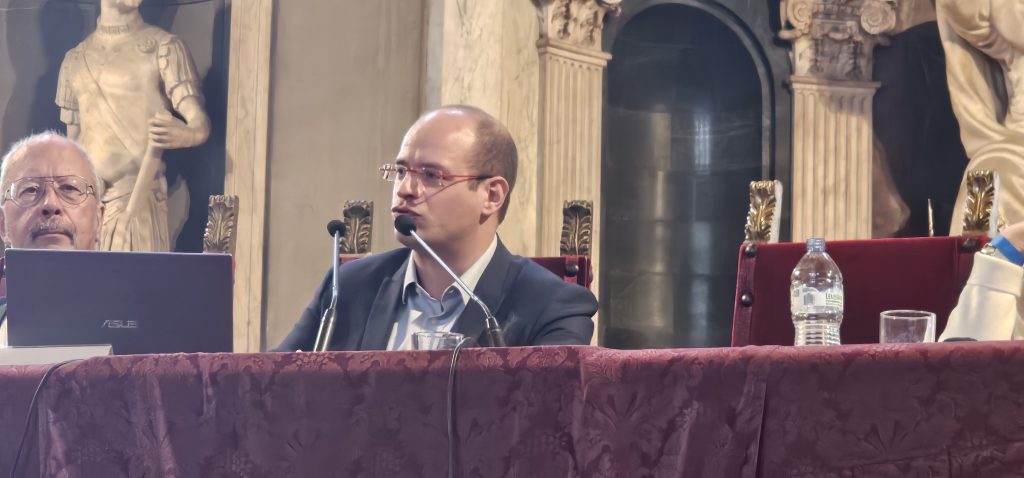
Presentation by Jean-Raymond Lemaire, Expert, Founding Chairman of the EEEI and co-leader of the Find an Expert II project, reported by Priscilla Pisani, Expert
Find an Expert II is now over, and we are awaiting funding for FindEx III. The overall objective remains the creation of a European register of all European experts, both men and women, already registered in an official list for each country (national or regional), available on the E-Justice website, and therefore at the level of the European authorities, and intended to cover the whole of Europe.
Jean-Raymond Lemaire illustrated the results of FindEx II:
selection criteria for judicial experts
recommendations for the management of registers of judicial experts
a first initial definition of a unique nomenclature of competences
an IT Prototype which can be the initial version of the European register of experts, which was tested online during the conference with practical examples.
The challenges ahead in the coming years include:
gradual harmonization of selection criteria for experts and registration on the lists that do not exist today (to achieve this harmonization gently will take 5–10 years)
convergence of the nomenclature of expertise so that it will be uniform or unified, although this will be complicated to achieve
the question of how to evaluate experts, although this has not yet been considered to date
resolution of the problem of gender inequality among experts as the European Commission is calling for equity in all activities in the coming years
Communication between judicial experts, judges/magistrates/prosecutors, lawyers and Ministries of Justice, that is all interested/involved parties, will also be crucial for the future of judicial expertise and for making the activities of judicial systems work in Europe.
VR-Digijust
Presentation by Robert Ranquet, Expert and EEEI Vice-President
This project is focused on criminal matters. It is based on the observation that there are many instruments for European cooperation in criminal procedure, such as the European arrest warrant, the European search order and the European confiscation order. But these tools for European cooperation are not all that easy to implement. And magistrates, public prosecutors, judicial police officers and all those involved in implementing these procedures and instruments in cross-border cases are encountering difficulties. There was therefore a need to help them make better use of these instruments, and therefore to train them.
This is a training project aimed primarily at magistrates, but also at judicial police officers, lawyers, experts and all those involved in these procedures. The idea is to create a European network of virtual training centers in which the various publics concerned can find training adapted to their needs.
The project is therefore being run by a consortium led by our Italian friends, a number of Italian courts and jurisdictions, including the Court of Appeal of Venice, the Court of Appeal of Florence, the Court of Appeal of Milan, and a non-governmental organization very active in the field of training in the rule of law and human rights, Agenfor, which is the project leader, and other partners in Europe, including EPLO (Athens Institute of Public Law), the Bremen Institute of Public Law in Germany, the two French and Belgian Chambers of Commerce and Justice Commissioners, and our Institute. Within this consortium, our Italian friends are the leaders. The Institute is a partner, so we take part in all the work, but we have some particular tasks to carry out: creating a database of contacts shared with all the members of the consortium, organizing practice conferences in France, Germany, Italy, and Greece. The practice conference held in Paris in April 2023 was co-organized with our friends from the French chamber of judicial commissioners. It enabled a number of needs and ideas to be put forward directly by those involved in the procedure. We brought together magistrates, lawyers, experts and judicial commissioners to hear their needs. From there, we worked to define training modules, dealing with the various subjects requiring training. A training catalog is currently being drawn up, alongside the introduction of training tools, in which we intend to make very deliberate and vigorous use of the possibilities offered by virtual reality. The idea is to be able to offer magistrates and other system users training in virtual environments of the metaverse type, with real-life situations in the virtual universe, for example simulating a hearing, a trial, an investigation into a crime scene, etc., all supported by the new technologies now available to us in the metaverse.
We are indeed very visionary in this approach, and the prototype of this system has just been set up. It is currently being tested within the consortium and, over the next few months, it will be fine-tuned, developed, extended and offered to the various players in several jurisdictions that have volunteered to take it forward before delivering it turnkey to the European Commission. We are currently halfway through the project and still have a year and a half ahead of us.
Robert Ranquet’s presentation on the VR-Digijust project, as part of the moral report, was supplemented in the afternoon by a talk by Sergio Bianchi.
Digital Rights
Robert Ranquet then gave a brief presentation on the Digital Rights project, for which a proposal has been submitted.
This project is being conducted with more or less the same consortium and piloted by our Italian friends at the Venice Court of Appeal with the same players in a completely different field, that of digital evidence. For example, there may be cases involving criminals dealing in Bitcoin or whatever, in a digital universe with digital evidence, or digital evidence relating to material offenses committed in the real material universe, but for which the evidence is of a digital nature. It is now quite clear that the entire chain of identifying, locating, acquiring, storing, handling and processing digital evidence poses a number of technical and organizational difficulties that require us to be extremely careful in the way we handle evidence. The main idea behind the digital rights project is to help the various players involved, including forensic experts, who will be on the front line as it is they who most often acquire, handle and use this evidence. As with the previous project, our institute will be involved in all the project’s tasks, and more specifically in steering work package number 5 on communication, dissemination and exploitation of the project’s work. This time it’s a two-year project, with a limited budget — we’re one of several partners in the consortium – and the project itself will cost around €70,000.
For these two projects, the Institute is working in the criminal field for the first time, since until now, virtually all our activities have been in the civil field.
CEPEJ
Presentation by Alain Nuée, Honorary First President of the Versailles Court of Appeal, Chairman of the EEEI Steering Committee.
Our second partner in Europe is the Council of Europe, and more specifically the European Commission for the Efficiency of Justice (CEPEJ), to which we have been an observer for the past ten years. The CEPEJ supports judicial reforms in the 47 member states of the Council of Europe that have signed up to the European Convention on Human Rights under the jurisdiction of the European Court of Human Rights in Strasbourg. For some time now (you know why) Russia and Belarus have been suspended from the Council of Europe and therefore no longer active in the CEPEJ, so the Commission for the Efficiency of Justice’s main means of action is to publish recommendations that it tries to reach by consensus. It provides guidelines, standards and, above all, what the States are very keen on, it provides performance indicators and, every 2 years, it produces a report on the efficiency of each judicial system, which enables the 45 countries to compare themselves and see where their judicial systems need to be improved in terms of efficiency.
This evaluation is therefore very important and is organized into different working groups. The evaluation working group produces this report every two years, through a process of collating statistics and information supplied by the Member States. In addition, the SATURN working group has been set up to look at one of the key issues in judicial systems, namely the time taken to obtain a decision. The CEPEJ is also interested in the application of computer systems or new technologies that may exist and that can improve the functioning of justice. In this context, it has created a special group, the cyberjustice working group. Finally, speed and quality must go hand in hand, and quality criteria are set by the GT-QUAL working group. It is within the framework of this working group that the assessments of judges and eventually the assessment of experts will be proposed.
Scientific Committee
Etienne Claes explained the composition and role of the Scientific Committee, none of whose members were present at the General Meeting.
Gilles Cuniberti, Professor of law at the University of Luxembourg
Dory Reiling, Independent IT and judicial reform expert, Honorary Senior Judge, Amsterdam District Court
Jacques Sluysmans, Professor at Radboud University Nijmegen, Advocaat, The Hague
Vincent Vigneau, Commercial Chamber Chair at French Cour de Cassation, Associate Professor at the University of St Quentin-en-Yvelines
The new individual members of the Executive Committee
Jean-Baptiste Drouet — FR Expert at the Nancy Court of Appeal and Administrative Court of Appeal, in the soil field.
Giovani Esposito — IT Expert, President of the CNPI.
Marc Lissens — BE ISPRM Member — International Society of Physical and rehabilitation medicine.
Carlo Pilia — IT University — Professor of Civil Law, University of Cagliari, CNPI consultant
Priscilla Pisani — IT
Acoustics expert, founding member of AICEF.
Communication
Martine Otter gave a brief presentation of communications at the Institute, illustrating the 2023 activities: the major work of supporting the FindEx II project (raising awareness, motivating and disseminating results), monitoring the dissemination of information on how expertise works in Europe, making the website and communications bilingual, and facilitating communication between members of the Institute, thanks to Nathalie who knows and maintains contact with and between everyone! Finally, she called for male participation in the Institute’s communications team, which has a “reversed” gender disparity: there are only women!
Ethics and finance
The financial report and the 2024 budget were presented by Fernand Maillard, the new EEEI treasurer, who reminded the meeting that the EEEI operates essentially on membership fees and partly on co-financing from the European Union. We have no direct or indirect sponsorship from private companies. He also pointed out that the permanent team is very small, with a part-time secretary, and that the EEEI operates entirely on a voluntary basis.
The moral and financial reports were unanimously approved, as was the appointment of the new members of the Executive Committee.
Presentation of Confgiustizia by Professor Franco Pagani
Audio recording
The morning ended with a guided tour of the Palazzo Vecchio, followed by an afternoon of lectures.
We use cookies and similar technologies to ensure our website works properly, personalize your browsing experience, and analyze how you use our website. You can learn more about how we use cookies by visiting our privacy policy page You can choose below whether or not to enable cookies that are not essential to the operation of the site.
You can revoke your consent at any time by using the "Revoke consent" button.
















 Français